Review of the Lobbyists Code of Conduct
2022-11-30 by Chris Moffatt Armes
Discussing proposed changes to the Code, and how PoliTraQ can help your team stay compliant.
Earlier this month, Commissioner of Lobbying of Canada, Nancy Bélanger, referred the draft third edition of the Lobbyists' Code of Conduct to the Standing Committee on Access to Information, Privacy and Ethics (ETHI), as required by the Lobbying Act.
The committee's study of the draft code will mark the final stage in a year-long consultation with the government relations sector, which aims to address shortfalls and ambiguity in the existing Code, while, "setting appropriate and workable ethical standards for lobbyists that support free and open access to government."
Though the Code of Conduct is a non-statutory tool (meaning lobbyists cannot be fined or imprisoned for violating the Code), those who run afoul of its requirements are subject to an investigation and report, delivered to Parliament. This creates a strong incentive to follow the Code, as the risk of damage to one's professional reputation and career trajectory is substantial.
In this edition of the PoliTraQ blog, we'll look at two of the major proposed changes - including prohibitions on lobbying those with a "close relationship" to the lobbyist, as well as changes to the rules around hospitality and gifts.
As a platform built by, and for, Canadian government relations practitioners, PoliTraQ is committed to serving the specific needs of our clients. That's why today's blog will also serve to announce the launch of two new tracking features, aimed at ensuring compliance with the new edition of the Code. We're excited to launch these tools in advance of the formal implementation of the updated Code, to allow for an easy transition and onboarding process.
Hospitality and Gifts
Under the 2015 edition of the Lobbyists' Code of Conduct, lobbyists are prohibited from providing gifts, favours, or other benefits to an official that the official is not allowed to accept.
As anyone who has run a lobby day reception, or hosted officials for visits, tours, and meetings can tell you, this rule has created a ton of unnecessary confusion. Designated Public Office Holders (DPOH), depending on their role (MPs, cabinet, public servants, staff, etc.) are each subject to at least one code of conduct or other set of requirements.
By placing the onus on the lobbyists to know not only their own Code's requirement, but the codes of conduct for all attendees at any given engagement, this rule has proven challenging to uphold and enforce.
According to the Commissioner, feedback from the sector on this issue varied widely - from proposals for a blanket ban on gifts and hospitality, to the continuance of the status quo. The new draft Code imposes a $40 low-value limit for a 'token of appreciation or promotional item' or 'food or beverage for consumption during an in-person meeting, lobby day, event or reception,' with each subject to an $80 annual limit.
For example, a lobbyist could provide refreshments at a lobby day reception, or a small token gift, but the total value (per official) could not exceed $40. The lobbyist could hold two such events - or give two such gifts - per year, without exceeding the annual limit.
Prohibitions on Lobbying
The 2015 edition of the Lobbyists' Code of Conduct includes two rules regarding preferential access in circumstances where the relationship between the lobbyist and official could be seen to create a sense of obligation. These rules prohibit lobbyists from directly lobbying - or in the case of consultant lobbyists, arranging meetings - with these officials.
The updated Code combines these rules into one, while providing clearer definitions around the types of relationships impacted. These include family, close working/professional, or business/financial relationships between officials and lobbyists.
Further, the existing Code prevents lobbyists from lobbying an official (or their staff) if they have undertaken political activities on behalf of the official which could reasonably be seen to create a sense of obligation. The new rule continues this prohibition, while outlining the types of work (paid or unpaid) and the cooling-off periods before a lobbyist can once-again engage with these officials (as well as their staff, parliamentary secretaries & their staff, etc.).
In the updated Code, "political work" is defined as "paid or unpaid work of a political or partisan nature for a candidate, official or political party during or between election periods." This is further divided into "strategic, high-profile or important work for a candidate, official or political party" (subject to a 24-month cooling-off period), and "political work involving frequent and/or extensive interaction with a candidate or official, or performed on a full-time or near-full-time basis for a candidate, official or political party" (subject to a 12-month cooling-off period).
Finally, the Code prohibits lobbying officials for whom there may be a perceived "sense of obligation". Criteria added in this section include if the lobbyist employed an official before they became an official, employed or continues to employ a close family member of the official, or "provided gifts or hospitality that exceeded the annual limits set in this Code to the official before they became an official."
Maintaining Compliance
As you can see from the brief summary above, the proposed changes to the Code are not overly onerous, but do represent a new set of criteria for lobbyists to consider prior to engaging with an official. Further - unlike the blanket cooling-off period for former DPOH's entering the government relations field - the time limits and scope of these prohibitions could create confusion.
While the final language of the Code (as well as the specific values/time periods) may still change in Committee, we decided to move early and begin implementing changes to the PoliTraQ platform to allow users to track per-official hospitality and gift spending, as well as individual or blanket prohibitions on lobbying.
Users can add prohibitions to their account from the Edit User page - accessible through the Account page. Here, they can select the Contacts they're prohibited from lobbying, as well as the type of prohibition & its expiration (if applicable).
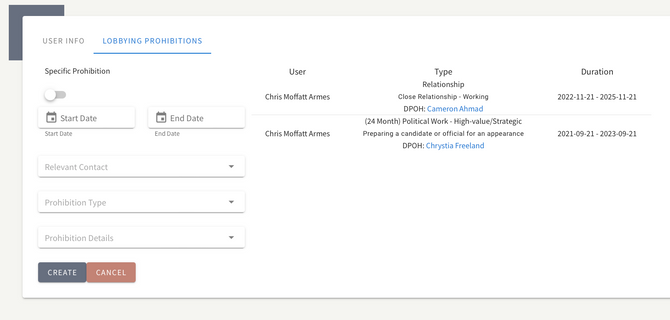
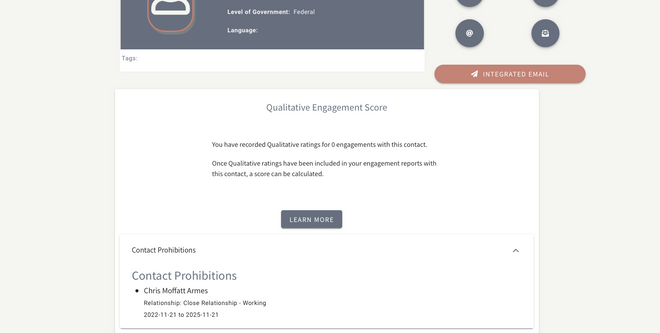
This information will automatically be displayed on the Contact's profile, so all members of your team can be on the same page.
We've also added a Gifts and Hospitality field for all Contact entries moving forward, which will allow you to track any relevant spending in this domain. New items can be added by visiting the Edit Contact page - similar to how new addresses or social profiles are added.
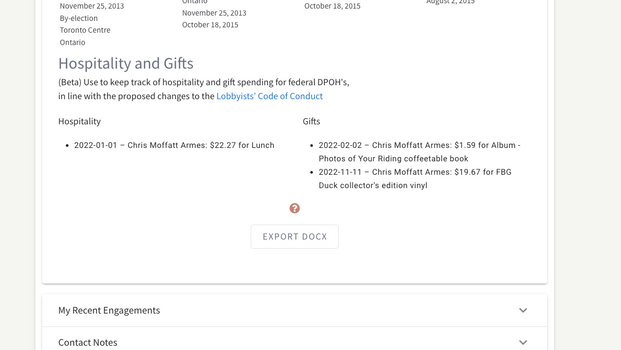
These new features are still in beta, and we anticipate making a number of changes over the coming weeks and months. However, by getting them up and running now, you'll have a chance to get into the habit tracking these fields.
If you have any questions or feedback, please don't hesitate to reach out by email to chris@politraq.com.